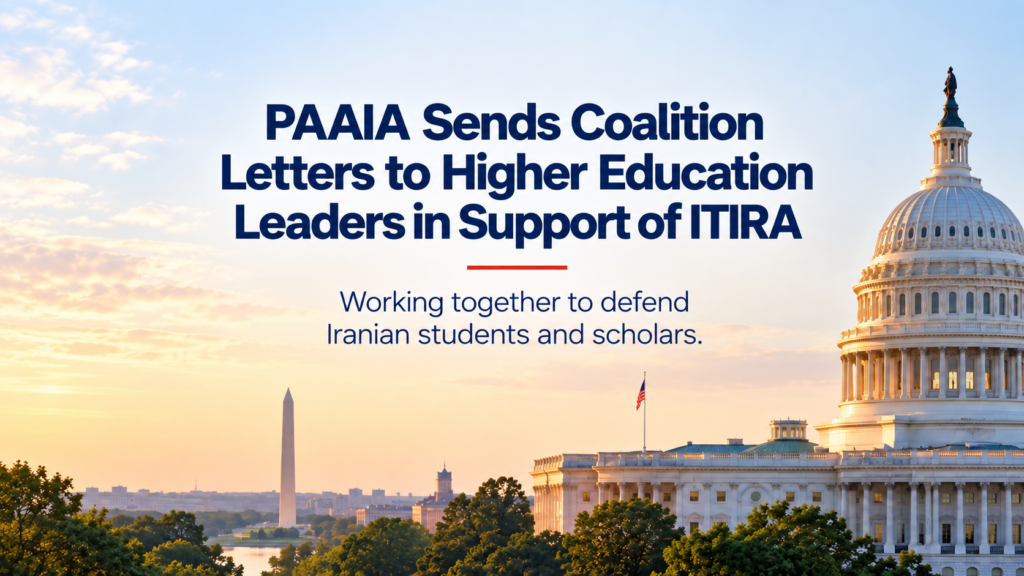


PAAIA is taking action at this critical moment for Iranian students and scholars in the United States.
Last week, PAAIA – alongside Pars Equality Center and the Iranian American Legal Defense Fund – sent coalition letters to leading higher education advocacy organizations, including the Presidents’ Alliance on Higher Education and Immigration and the National Association of Independent Colleges and Universities, urging them to support the Iranian Temporary Immigration Relief Act (ITIRA), H.R. 8740, and encouraging their networks to do the same.
This outreach reflects an important next step in our advocacy: bringing the voices of colleges, universities, and higher education organizations into a conversation that directly affects students, scholars, researchers, and the institutions they serve.
READ THE HIGHER EDUCATION COALITION LETTER
Why Higher Education Must Have a Voice
Iranian students and scholars have long come to the United States to study, conduct research, and build careers that contribute to American universities, businesses, and communities. Today, however, some Iranian nationals who are lawfully present in the United States continue to face immigration uncertainty that can affect their ability to study, conduct research, work, and plan their futures.
Beginning in late 2025, a USCIS adjudication pause affecting certain immigration applications created significant uncertainty and processing delays. A federal court subsequently ordered USCIS to resume adjudications, but litigation has continued. In August, the U.S. Court of Appeals for the First Circuit considered the government’s request for a stay pending appeal.
For students and scholars, prolonged immigration uncertainty can have consequences far beyond an individual immigration case. It can disrupt education, research, employment, and the ability of universities and laboratories to retain talented individuals who are already contributing to their institutions.
That is why higher education organizations have an important role to play. Their voices can help demonstrate to policymakers how immigration uncertainty affects not only individual students and scholars, but also the American institutions and communities that rely on their contributions.
What ITIRA Would Do
ITIRA is designed as a targeted, temporary response for eligible Iranian nationals already in the United States whose good-faith immigration applications were affected by the adjudication pause and resulting delays.
As outlined in the coalition letter, the legislation would provide qualifying individuals with temporary protections and employment authorization while their immigration applications are adjudicated. It also includes national security, criminal, inadmissibility, and regime-related safeguards.
For PAAIA, this effort is rooted in a simple principle: individuals who followed U.S. immigration law should not have their education, careers, and futures unnecessarily disrupted because their applications became caught in administrative uncertainty.
This Is a Moment for Collective Action
Our letters to the Presidents’ Alliance and NAICU are one part of a broader effort to ensure that the higher education community understands what is at stake. Now, we are encouraging colleges, universities, higher education associations, student organizations, professional groups, and community organizations to add their voices.
Individuals can also take action directly. PAAIA’s Action Center makes it easy to contact your Members of Congress and urge them to support ITIRA. Sending an action alert takes only a few minutes and helps demonstrate that there is broad constituent support for protecting Iranian students, scholars, and other eligible individuals affected by the adjudication delays.
TAKE ACTION THROUGH PAAIA’S ACTION CENTER
PAAIA Will Continue to Act
Sending these coalition letters is an important step, but our work does not end here. PAAIA will continue working with partner organizations, higher education stakeholders, community leaders, and policymakers to raise awareness of ITIRA and the circumstances facing affected Iranian nationals.
We encourage organizations across the country to join this effort. Read our coalition letter, download the template, share it with your institution or organization, and make your voice heard.
At this critical moment, broader engagement can help ensure that Iranian students and scholars are not overlooked and that the institutions benefiting from their talent have a voice in the conversation.